Wednesday, 3 August 2011

Mexico ups gold reserves by over 90 tonnes in two months

http://cnbusinessnews.com/mexico-ups-gold-reserves-by-over-90-tonnes-in-two-months/


Mexico massively ramped up its gold reserves in the first quarter of this year, buying over $4 billion of bullion as emerging economies move away from the ailing U.S. dollar, which has dipped to 2-1/2-year lows.
The third biggest one-off purchase of gold by any country over the past decade took Mexico’s reserves to 100.15 tonnes — or 3.22 million ounces — by the end of March from just 6.84 tonnes at the end of January, according to the International Monetary Fund and Mexico’s central bank.

Gold has gained 11 percent this year, driven by concern over euro zone debt and the violence in the Arab world, as well as by the U.S. dollar’s 7.6 percent decline against a basket of currencies .DXY.
Sergio Martin, chief economist for HSBC in Mexico, said the government probably saw gold as a highly liquid asset that would reduce exposure to the falling greenback.

“They’re probably thinking that getting out of dollars and into gold makes sense because we know that the dollar has some trend to depreciate in the near future at least,” said Martin. “I don’t think they’re going to lose money with this.”
Mexico’s foreign currency and asset reserves hit a record $128 billion in April, making the gold purchased mostly in February and March worth nearly 4 percent of that total. Mexican central bank data on gold holdings only exists through March.
The central bank did not respond to a request for comment.
According to the International Monetary Fund, Latin America’s No. 2 economy now owns $4.93 billion worth of gold XAU=, which hit a record $1,575.79 an ounce on Monday.
Other emerging economies such as China, Russia and India have also beefed up bullion reserves over the past few years.
SILVER LINING?
Credit Suisse precious metals analyst Tom Kendall said it was worthy of note that Mexico, whose economy is very closely tied to the United States, had taken this step.
“The size (of the purchase) is certainly pretty chunky to have been accomplished in that space of time. So it certainly gives another sizable layer of support to gold’s position in the international reserves system,” he added.
George Milling-Stanley, managing director of government affairs at the World Gold Council industry group, said Mexico was following a recent trend among central banks to restore a “prior balance between gold and currency reserves.”
“This is further supported by the fact that the May IMF numbers show continued buying by Russia and Thailand of 18.8 tonnes and 9.3 tonnes respectively,” he added.
Mexico’s reserves rank it 33rd among the top official holders of gold. The United States is the largest official holder of gold, with 8,133 tonnes, which account for 73.8 percent of its total international reserves.
China is the sixth largest holder of gold, with 1,054.1 tonnes, or just 1.6 percent of total reserves, while eighth-ranked Russia now has some 811 tonnes of gold, up from 788.78 in January, according to the IMF data.
Silver, which hit a record price earlier this year, may also have been on Mexico’s buying list, said Martin at HSBC.
“I think Mexico has moved from second to first place in the list of global silver producers, so they may have been buying silver to help the price,” he added.
Source: Reuters

Thursday, 28 July 2011

South Africa's gold miners begin strike over pay

http://www.bbc.co.uk/news/world-africa-14324063


Almost 100,000 gold miners have begun an indefinite strike in South Africa calling for a 14% salary increase.
The stoppage could cost the gold mining sector $25m (£15m) a day in lost output, economists say.
The National Union of Mineworkers (NUM) told the BBC it would affect all the top gold producers who are only offering between 7% and 9% pay rises.
The coal and petrol sectors have also been hit by strikes leading to fuel shortages in the last three weeks.
The BBC's Pumza Fihlani in the commercial capital, Johannesburg, says this time of the year is known as South Africa's "strike season".
Most unions are demanding salary increases twice that of inflation - which currently stands at 5%.

Start Quote

Our members work under dangerous conditions... yet they have nothing to show for it”
End Quote Lesiba Seshoka NUM spokesperson
They argue that any reasonable increase in wages needs to be 11% to counteract price hikes in food, water, electricity and petrol over the past year.
NUM spokesperson Lesiba Seshoka said workers would down tools indefintely from the start of the night shift on Thursday at 18:00 local time (16:00 GMT) in all gold mines, including AngloGold Ashanti, Gold Fields and Harmony Gold.
"Our members work under dangerous conditions in the mines daily and yet they have nothing to show for it," Mr Seshoka told the BBC.
The average mine worker earns 3,800 South African rand ($570; £346) each month, according to NUM.
For decades gold mining was the backbone of South Africa's economy, but gold output has decreased in recent years.
Until 2007 the country was the world's largest gold producer, now it is fourth.
The decline has been attributed partly to an increase in labour costs.
According to the most recent World Economic Forum report on Global Competitiveness, South Africa had the eighth-highest level of industrial conflict of out of 139 countries.
A public sector strike over pay paralysed schools and hospitals for more than a month last year.

Thursday, 21 July 2011

Griffiths goes for gold - again

Mike Foster
21 Jul 2011
Back in mid-May, the price of gold, at $1.490 an ounce, was looking soggy. But poor sentiment didn’t put Robin Griffiths of Cazenove Capital off the yellow metal. On the contrary, he decided the traditional summer lull would come to an end early – by June 29, to be precise.
Following a 0.68% rise to $1.510 that day, we waited three weeks to see whether Griffiths had got it right. And the subsequent rise in the price of gold to $1,600 saw him pass the test with flying colours.
Griffiths is renowned as a technical analyst, extrapolating probable futures from charts of price trends, while taking account of seasonal factors and key fundamentals. He now thinks gold will track higher during the summer towards $1,650 or $1,700.
In the autumn, things will get interesting. He said: “It is my belief that gold will go ballistic at that point. You get that time and again, when you get a breakout.”
According to a chart published by advisory firm Institutional Investors, attached, it wouldn’t be hard to get the price to $2,155 in short order. Griffiths wouldn’t be surprised to see it hit $3,000, or $5,000 in inflation adjusted terms, by 2015.
But Griffiths goes further – as he often does. He takes the view the market will become increasingly nervous of the debasing of currencies being pushed through by governments desperate to restore sentiment to the debt market.
He believes the consumer price index is beloved by politicians because it understates inflation: “A fall in the price of the latest iPad was deemed worthy of inclusion in the index, helping to offset a rise in food prices. But, as far as I am aware, you can’t eat an iPad.” He believes that investors in India and China are increasingly likely to hedge their bets with gold.
To underline the case for the safe haven, Griffiths argues the technical position for Western markets is deteriorating fast. The French CAC 40 index is leading the way down with short term sentiment, indicated by the 50-day moving average, deteriorating faster than the 200-day average. Griffiths warns the UK, US and German indices are likely to follow in short order.
It's being so happy that keeps him going.

Saturday, 25 June 2011

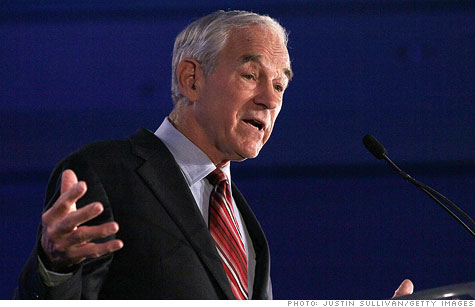
Ron Paul worries Fort Knox gold is gone

WASHINGTON (CNNMoney) -- With the price of gold at record highs, presidential candidate Rep. Ron Paul wants to make sure the U.S. gold bars at Fort Knox are really there.
Paul called a congressional hearing Thursday to grill federal officials about his bill to audit and inventory all of the gold reserves at Fort Knox, Ky., West Point, N.Y., and Denver, even though Treasury officials insist that the gold is audited annually and is all there.

During the hearing, Paul suggested that the Federal Reserve of New York, which has 5% of the U.S. gold reserves, has the ability to secretly sell or swap gold with other countries without anyone knowing.
"The Fed is pretty secret, you know," said Paul, who leans Libertarian. "Congress doesn't have much say on what's going on over there. They do a lot of hiding."
Paul, a Texas Republican who wants to convert the U.S. monetary system to one based on the gold standard, says the federal government owes it to taxpayers to make sure U.S.-owned gold is safe. (Ron Paul: Bernanke's biggest critic)
"This is one of the few legitimate functions of government: To check our ownership and be fiscally responsible and find out just what we own and whether it's really there," said Paul, who is among those running for the Republican presidential nomination.
Audits by the Treasury Department and Government Accountability Office are based on samples. Paul wants to open up Fort Knox and other reserves and count the bars manually.
"We know where it is. We know how much there is. We know it's there. None of it has been removed," said Treasury Inspector General Eric Thorson.

Ron Paul, John Boehner, Nancy Pelosi: Peek at their wealth

In September, Treasury completed its latest audit, showing that U.S. gold reserves total 9,300 tons with a market value of $320 billion, Thorson said. The recent run-up in gold prices -- the precious metal is trading at about $1,515 an ounce -- puts the market value at $340 billion as of Wednesday, according to Thorson's testimony. He added that each gold bar weighs about 27 pounds and is worth around $500,000.
Paul said that his questions were partly in response to the numerous Internet conspiracy theories, including those that accuse the government of secretly selling all of the gold in Fort Knox.
Thorson said Treasury doesn't believe that anyone, including the Fed, has taken the gold or laid claim to U.S. gold bars. Any further audit as proposed by Paul's legislation would be redundant, he said.
"There is no movement. There is nothing there that can happen, once those doors are sealed," Thorson said. "It's very obvious if those seals are ever broken."
William Lacy Clay, a Democratic representative from Missouri, said that doing a complete audit as Paul is calling for is a waste of federal manpower and could cost tens of millions of taxpayer dollars.
Thorson reported that the U.S. Mint told him that moving, counting and testing the gold would cost around $60 million. Paul said he had heard from Treasury that it would only cost $15 million.
Part of the expense would be due to the bill's requirement to "assay" all the gold, said Gary T. Engel, a director of Financial Management and Assurance at GAO. Assaying means drilling little holes in all the gold bars in order to test its purity. But that process is "basically destroying whatever that piece is."
Finally, Engel cautioned, "There will be some loss of the gold from the bars through the assaying process if you do that for every single bar that's out there." To top of page

GREEK SAVERS RUSH FOR GOLD

By Kerin Hope in Athens

Published: June 21 2011 13:50 | Last updated: June 21 2011 22:34

Greek citizens are emptying savings accounts and buying gold as they brace themselves for the possibility of a sovereign default and a run on the banks.

Pledges by socialist prime minister George Papandreou that his government would “save the country” have been widely discounted by the public.

Sales of gold coins have soared as savers seek a safer and fungible source of value.

“When the global financial crisis started, our sales of coins to investors overtook bullion for the first time,” said Harry Krinakis, at Sepheriades, a Greek precious metals trader. “Now the sales ratio has reached five to one.”

Tomas, a computer technician, has exchanged his euro savings for gold coins: “I keep them at home just like my grandmother did in the second world war.”

....

Monthly bank withdrawals were running at €1.5bn-€2bn (£1.3bn-£1.8bn) in the first quarter. Last year, depositors withdrew €30bn, equivalent to 12.3 per cent of total savings, according to the central bank. Greek deposits worth an estimated €8bn were transferred to banks in Cyprus in 2010. But the flow has dried up this year amid fears that Cypriot banks could suffer contagion.

LINK:

http://www.ft.com/cms/s/c986823e-9bf8-11e0-bef9-00144feabdc0,Authorised=false.html?_i_location=http%3A%2F%2Fwww.ft.com%2Fcms%2Fs%2F0%2Fc986823e-9bf8-11e0-bef9-00144feabdc0.html&_i_referer=http%3A%2F%2Fsearch.ft.com%2Fsearch%3FqueryText%3Dgreek%2Bsavers%26ftsearchType%3Dtype_news#axzz1QI8ebrvr

Is Gold Flying Under the Radar?

Is Gold Flying Under the Radar?

It’s hard for Americans to understand that gold is an asset that reflects global confidence, not just confidence in America. So arguments against gold that are focused just on America are not entirely valid to me. Even if we solved our debt problems, which is unlikely, there still would be huge sovereign debt crises in the Euro zone and Japan. Although gold would not rise as much as it would with a U.S. debt collapse, it would do just fine because these problems are global.
It is natural for people to think only in terms of their currency when pricing various assets. Because of this currency bias, Americans probably don’t realize that gold is approaching its highs in terms of Euros. Earlier today gold made new all-time highs in British pounds.
We think in terms of demand in the U.S. or inflation rates in the U.S. But are people rioting in Greece not allowed to buy gold? What about people in Spain who see a huge crisis coming? What about people retired in Japan who have been living through a 2 decade depression that is only getting worse? What about people living in nations in Africa and the Middle East that are experiencing social unrest? We must try to understand that it is not only about us.

For years all I’ve been hearing is that the global economy will get better and that the debt crisis is behind us. Instead civil unrest actually rises while the economy stagnates. I’ve previously written about how “bad” things tend to cluster together historically. Why is it that we are experiencing a sovereign debt crisis at the same time we have droughts around the world? I’m not sure, but this is what happened during the Great Depression too. These type of things cycle, and we must deal with it intelligently.
Rising food prices due to the falling dollar and extreme weather globally are creating serious civil unrest around the world. This is the kind of civil unrest that will eventually spread throughout Europe and the U.S. No one has jobs, prices are rising, and our governments are broke. It doesn’t take a genius to figure out this is a formula for serious problems down the line.
Although I presume most people who read this blog are gold bugs, I’m pretty sure most of you are not rushing out to buy gold at $1500. Gold equities look very attractive to me, but I’m also pretty sure most of you are not buying into weakness. So if even gold bugs are apathetic about gold right now, what do you think about everyone else? And are bull markets built on a foundation of apathy or excitement? I’m telling you that the price action in gold is extremely bullish and that this will be very apparent in hindsight.
I am just about pounding the table that you should be buying gold in this period of consolidation. Gold stocks have taken a beating with the stock market even though gold has held up pretty well the last couple of months. These are the kind of divergences you should try to capitalize on. I am loving it that people are apathetic even though gold is approaching its all-time highs; this suggests to me that we may be seeing a rocket launch move soon.


These 90 Analysts Believe Gold Will Go to $5,000/ozt. – or More!

Of the 133 analysts who have now gone public in maintaining that gold will eventually go to a parabolic peak price of $2,500/ozt.+ before the bubble bursts, 90 – yes 90, maintain that gold will reach at least $5,000 per ozt. Take a look here at who is projecting what, by when.
Editor’s Note:
1. If you find a name missing from the list below send it to me (editor-at-munKNEE-dot-com) with the URL of the article in which the individual states his/her case so keep the list the most comprehensive on the internet. Only projections of at least $2,500 per troy ounce, accompanied by sound reasons, will be included in the revised list.

3 Analysts See Gold Reaching its Parabolic Peak Sometime in 2011!
  1. Bob Kirtley: $10,000;
  2. Patrick Kerr: $5,000 – $10,000;
  3. Taran Marwah: $3,000;
10 Analysts See Gold Reaching its Peak By the End of 2012
  1. Arnold Bock: $10,000;
  2. Porter Stansberry: $10,000;
  3. Taran Marwah: $6,000+;
  4. Greg McCoach: $5,000+;
  5. Robert McEwen: $5,000;
  6. Mary Anne and Pamela Aden: $3,000 – $5,000;
  7. John Paulson: $2,400 – $4,000;
  8. Ian McAvity: $2,500 – $3,000;
  9. Peter Hambro: $2,500;
  10. Charles Nenner: $2,500
These 11 Analysts See Gold Going Parabolic to +$10,000
  1. DoctoRX: $20,000 (by 2020);
  2. Mike Maloney: $15,000;
  3. Ben Davies: $10,000 – $15,000;  
  4. Howard Katz: $14,000;
  5. Jeffrey Lewis: $7,000 – $14,000;
  6. Jim Sinclair: $12,455;
  7. Goldrunner: $10,000 – $12,000;
  8. Martin Armstrong: $5,000 – $12,000 (by 2015/16);
  9. Robin Griffiths: $3,000 – $12,000 (by 2015); 
  10. Jim Rickards: $4,000 – $11,000;
  11. Roland Watson: $10,800;
These 46 Analysts See Gold Price Peaking Between $5,001 and $10,000
  1. Bob Kirtley: $10,000 (by 2011);
  2. Arnold Bock: $10,000 (by 2012);
  3. Porter Stansberry: $10,000 (by 2012);
  4. Peter George: $10,000 (by 2015);
  5. Tom Fischer: $10,000;
  6. Shayne McGuire: $10,000;
  7. Eric Hommelberg: $10,000;
  8. David Petch: $6,000 – $10,000;  
  9. Gerald Celente: $6,000 – $10,000;
  10. Egon von Greyerz: $6,000 – $10,000;
  11. Peter Schiff: $5,000 – $10,000 (in 5 to 10 years);
  12. Patrick Kerr: $5,000 – $10,000 (by 2011);
  13. Peter Millar: $5,000 – $10,000;
  14. Roger Wiegand: $5,000 – $10,000;
  15. Alf Field: $4,250 – $10,000;
  16. Jeff Nielson: $3,000 – $10,000;
  17. Dennis van Ek: $9,000 (by 2015);
  18. Dominic Frisby: $8,000;
  19. Paul Brodsky: $8,000;  
  20. James Turk: $8,000 (by 2015);
  21. Joseph Russo: $7,000 – $8,000;
  22. Bob Chapman: $7,700;                        
  23. Michael Rozeff: $2,865 – $7,151;
  24. Jim Willie: $7,000;
  25. Greg McCoach: $6,500;
  26. Dylan Grice: $6,300;
  27. Chris Mack: $6,241.64 (by 2015);
  28. Chuck DiFalco: $6,214 (by 2018);                                                        
  29. Jeff Clark: $6,214;                                                                                          
  30. Aubie Baltin: $6,200 (by 2017);
  31. Murray Sabrin: $6,153;                                                                                                      
  32. Adam Hamilton: $6,000+;                                                     
  33. Samuel “Bud” Kress: $6,000 (by 2014);
  34. Robert Kientz: $6,000;
  35. Harry Schultz: $6,000;
  36. John Bougearel: $6,000;
  37. David Tice: $5,000 – $6,000;
  38. Laurence Hunt: $5,000 – $6,000 (by 2019);
  39. Taran Marwah: $3,000 – $6,000+ (by Dec. 2011 and Dec.2012, respectively);       
  40. Martin Hutchinson: $3,100 – $5,700;
  41. Stephen Leeb: $5,500 (by 2015);
  42. Louise Yamada: $5,200;
  43. Jeremy Charlesworth: $5,000+;
  44. Przemyslaw Radomski: $5,000+;
  45. Jason Hamlin: $5,000+;
  46. David McAlvany: $5,000+                                   
Cumulative sub-total: 57
These 33 Analysts Believe Gold Price Could Go As High As $5,000
  1. David Rosenberg: $5,000;
  2. James West: $5,000;
  3. Doug Casey: $5,000;
  4. Peter Cooper: $5,000;
  5. Robert McEwen: $5,000 (by 2012 – 2014);
  6. Peter Krauth: $5,000;
  7. Tim Iacono: $5,000 (by 2017);
  8. Christopher Wyke: $5,000;
  9. Frank Barbera: $5,000;
  10. John Lee: $5,000;
  11. Barry Dawes: $5,000;              
  12. Bob Lenzer: $5,000 (by 2015);
  13. Steve Betts: $5,000;
  14. Stewart Thomson: $5,000;
  15. Charles Morris: $5,000 (by 2015);
  16. Marvin Clark: $5,000 (by 2015);
  17. Eric Sprott: $5,000;
  18. Nathan Narusis: $5,000;
  19. Bud Conrad: $4,000 – $5,000;
  20. Paul Mylchreest: $4,000 – $5,000;
  21. Pierre Lassonde: $4,000 – $5,000;
  22. Willem Middelkoop: $4,000 – $5,000;
  23. Mary Anne and Pamela Aden: $3,000 – $5,000 (by February 2012);
  24. James Dines: $3,000 – $5,000;
  25. Bill Murphy: $3,000 – $5,000;
  26. Bill Bonner: $3,000 – $5,000;
  27. Peter Degraaf: $2,500 – $5,000;
  28. Eric Janszen: $2,500 – $5,000;
  29. Larry Jeddeloh: $2,300 – $5,000 (by 2013);
  30. Larry Edelson: $2,300 – $5,000 (by 2015);
  31. Luke Burgess: $2,000 – $5,000;
  32. Marc Faber: $1,500 – $5,000;   
  33. Robert Lloyd-George: $5,000 (by 2014)                                                 
Cumulative sub-total: 90
31 Analysts Believe Gold Will Go Up to Between $3,000 and $4,999
1.    David Moenning: $4,525;
2.    Larry Reaugh: $4,000+;
3.    Ernest Kepper: $4,000;
4.    Mike Knowles: $4,000;
5.    Ian Gordon/Christopher Funston: $4,000;
6.    Barry Elias: $4,000; (by 2020);
7.    Jay Taylor: $3,000 – $4,000;
8.    Christian Barnard: $2,500 – $4,000;
9.    John Paulson: $2,400 – $4,000 (by 2012);
10. Paul Tustain: $3,844;
11. Myles Zyblock: $3,800;
12. Eric Roseman: $2,500 – $3,500 (by 2015);
13. Christopher Wood: $3,360;
14. Franklin Sanders: $3,130;
15. John Henderson: $3,000+ (by 2015 – 17);
16. Michael Berry: $3,000+ (by 2015);
17. Hans Goetti: $3,000;
18. Michael Yorba: $3,000;
19. David Urban; $3,000;
20. Mitchell Langbert: $3,000;
21. Brett Arends: $3,000;
22. Ambrose Evans-Pritchard: $3,000;
23. John Williams: $3,000;
24. Byron King: $3,000;
25. Ron Paul: $3,000 (by 2020);
26. Chris Weber: $3,000 (by 2020);
27. Mark Leibovit: $3,000;
28. Mark O’Byrne: $3,000;
29. Kevin Kerr: $3,000;
30. Frank Holmes: $3,000;
31. Shamik Bhose: $3,000 (by 2014)                                                               
Cumulative sub-total: 121
These 12 Analysts Believe Gold Will Go to Between $2,500 and $3,000
  1. Ian McAvity: $2,500 – $3,000 (by 2012);
  2. Jeff Nichols: $2,000 – $3,000;
  3. Graham French: $2,000 – $3,000;
  4. Bank of America Merrill Lynch: $2,000 – $3,000;                                                 
  5. Joe Foster: $2,000 – $3,000 (by 2019);                     
  6. David Morgan: $2,900;                                            
  7. Sascha Opel: $2,500+;
  8. Rick Rule: $2,500 (by 2013);
  9. Daniel Brebner: $2,500;              
  10. James DiGeorgia: $2,500;                
  11. Peter Hambro: $2,500 (by 2012);                                                                        
  12. Charles Nenner: $2,500 (by 2012 – 13)
Grand Total: 133
Conclusion
There you have it. Who would have believed that 133 distinguished analysts would maintain that gold and by implication, silver, are likely to achieve such lofty levels as a result of the effects of our current financially troubled and volatile times? Their rationale is varied but each is sound in its own right.
If we are to put any credence whatsoever into the rationale presented by the above analysts then it seems prudent to seriously consider owning some physical gold and silver and/or the stocks and/or long-term warrants of those companies that mine these precious metals.

WWW.PRECIOUS-METAL-INVESTMENT.BLOGSPOT.COM